
Discipline 01 · Entry point
Autocross
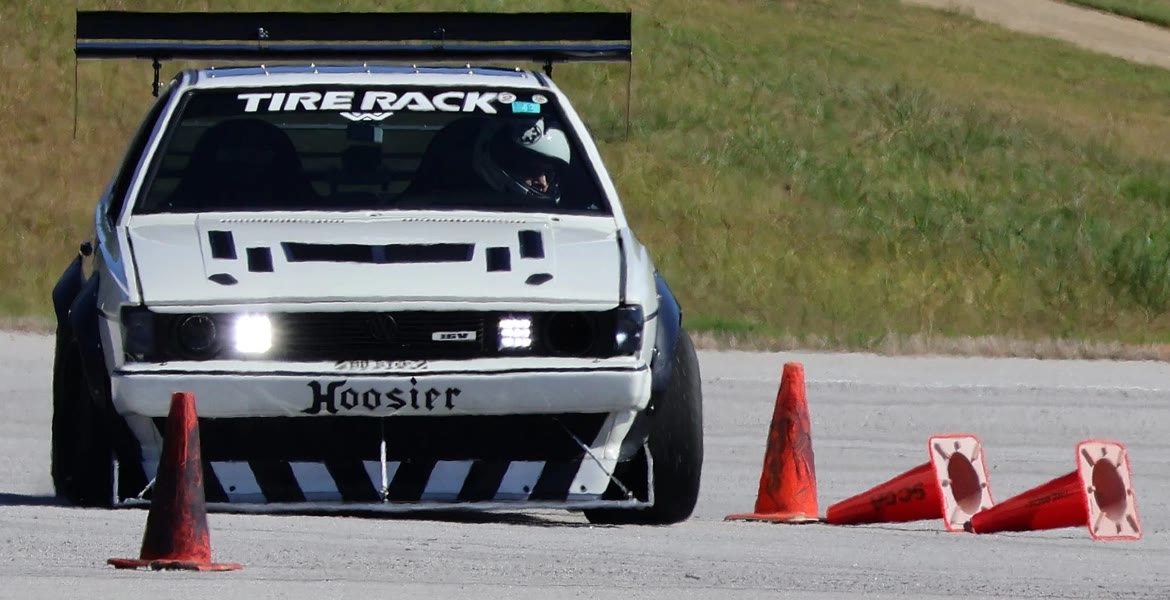
Racing the clock through a course marked out in cones. Cars are released one at a time and spaced so they never meet, nothing is coming the other way, and the fastest anyone goes is about the speed of a highway on-ramp. It is the cheapest, safest and least intimidating way into motorsport, and it is where most of this club started.
- Your car
- Whatever you driveStreet-legal, in sound mechanical condition. That is the whole list.
- Entry fee
- On MotorsportRegCurrent pricing is on each event's registration page, along with the weekend membership option for non-members.
- Runs per day
- Four, five if noviceNovices get an extra run. Each one is roughly 45 to 65 seconds.
- 2026 season
- Nine eventsTwelve competition days at zMAX Dragway and Michelin Proving Grounds, plus a novice school.
What it actually is
01 — The basicsA course is laid out in traffic cones across a very large piece of pavement, usually a stadium lot or a proving-ground skid pad. It is tight and technical: slaloms, sweepers, a couple of hairpins, a finish straight. You drive it alone, one car at a time, and a timing system records how long you took.
Hit a cone and you take a two-second penalty, which is enormous when the whole run is under a minute. Miss a gate and the run does not count. Otherwise, the fastest time wins.
More than one car can be on course at a time, but they are started far enough apart that they never meet. Combined with low speeds and a course made of cones, that makes autocross about as safe as motorsport gets. Cars are not modified for it in any required way. On a typical Saturday you will find a stock Civic parked next to a purpose-built tube-frame car, and both of them are having a good day.
You are not racing everyone
Cars are sorted into classes so that similar machinery competes against similar machinery. A lightly modified Miata is not measured against a 500 horsepower Corvette. There is also a PAX or index result that applies a handicap factor to every class, so you can see roughly how you did against the whole field regardless of what you drove.
If you have no idea what class your car is in, that is normal, and nobody expects you to arrive knowing. Use the classifier tool below, or just ask at registration and someone will sort you out in about ninety seconds.
Everybody works
This is the part that surprises newcomers, and it is the best part. The event is run entirely by the people competing in it. The field is split into groups: while one group drives, another group is out on course picking up knocked-over cones, and a third is doing grid, timing or starter duty.
Working a heat is the fastest way to learn where the time is, and it is the reason this sport is as cheap as it is. Plan on being at the event all day, not just for your runs.
How a typical day runs
02 — DayGates open
Roll in, find a spot in the paddock, and unload the car. There is no advantage to being first, but arriving early means you get through the rest of this list at a walk and with time to enjoy your coffee.
Registration and tech
Check in, sign the waiver, get your number and class confirmed. Tech inspection is a quick look over the car: battery secure, no loose items, no fluid leaks, wheels tight, throttle returns. It is not an inspection you can meaningfully fail in a well-maintained street car.
Novice course walk
Ask for this by name. An experienced driver walks the course with the first-timers and explains what they are looking at: where to brake, where the course is trying to trick you, which cone matters. Walk the course two or three more times on your own afterwards.
Drivers meeting
Everyone gathers. Safety brief, run group assignments, work assignments, and any course-specific notes. Short, and you need to be there.
First heat runs
Cars go out one at a time. Ask for an instructor to ride along on your first runs. They are free, they are volunteers, and they will take real time off your day.
Work, rest, drive
The field is split into run groups, usually three or four depending on entry numbers. Each group takes a turn at each job, so across the day you will work a heat, sit one out, and drive your own. Which order you get them in depends on which group you are assigned, and it is posted before the drivers meeting.
Your work heat is out on course retrieving cones, or on grid, timing or starter duty. Your rest heat is the one to use: eat, check your tire pressures, walk the course again, and watch the quick people in your class. Live timing runs at ccrscca.prontolivetiming.com, so you can see where you stand from your phone without leaving the paddock.
Done, and cleanup
Autocross typically wraps around four o'clock. Last runs finish, everyone helps pick up cones and load the trailer. Results are posted, trophies handed out at points events, and most people stand around talking about the one run they nearly had. Stay for that part.
2026 autocross calendar
03 — ScheduleNine points rounds and a novice school, split between zMAX Dragway and the Michelin Proving Grounds. Three of them run across two days. We usually open one registration at a time, so the round marked Open is the one taking entries now. Completed rounds link to their results.
Straight answers
04 — FAQCan I really run my daily driver?
Yes, and most people do. If it is street-legal, mechanically sound and passes a basic safety check, it can run. Front-wheel drive, all-wheel drive, automatic, manual, hybrid, EV, minivan: all of it has been autocrossed, and quite a lot of it has been autocrossed well.
Convertibles and cars with a high center of gravity have some extra requirements around rollover protection. If you drive a tall SUV or a truck, check the Solo rulebook or ask us before you enter.
Do I need to be an SCCA member?
No. The non-member entry includes a weekend membership covering you for that day. If you decide you like it, a full national membership makes you eligible for championship points and costs less per event across a season.
Current pricing for both is on the event's registration page.
Is it going to hurt my car?
Far less than a track day. Speeds are low, the runs are under a minute, and there is a long cool-down between them. You will use up front tires and brake pads faster than commuting does, and that is about the extent of it. Bring the car home the same way you brought it.
How many runs do I actually get?
Four runs on a normal day. Novices get five, because the first one is usually spent working out which way the course goes.
Each run is roughly 45 to 65 seconds of genuinely hard driving, with a long gap in between to think about what you just did. It is more useful seat time than it sounds.
Can I bring my partner, kids, or a friend?
Yes. Spectators are welcome and it is free to watch. Everyone entering the property signs a waiver, including minors with a parent or guardian. Bring chairs, sunscreen and water, because shade is not a guarantee at either venue.
Two drivers can also share one car. It is called co-driving, it costs a second entry fee, and it is a very common way for couples and friends to split the day.
What if I am slow, or I spin, or I flatten a lot of cones?
Then you will have had a completely normal first event. Everyone at that event was once exactly as lost as you are on your first run. Nobody is watching your times except you, and the person most likely to help you fix it is whoever just beat you.
How do I pay?
Pre-register on MotorsportReg and it is done before you arrive, which is also cheaper than signing up at the gate.
If you do pay on the day, we do not take cash. Card and check only.
What should I bring?
Water, sunscreen, a hat, a folding chair, closed-toe shoes, a tire gauge, and lunch or money for whatever food is on site. A helmet if you own one. Long trousers are not required but sun and hot pavement make them sensible.
Where are the events?
The 2026 season runs at zMAX Dragway in Concord, North Carolina and the Michelin Proving Grounds in Laurens, South Carolina. Specific dates are on the season schedule, and each event's registration page on MotorsportReg has the exact address and gate information.
Come do the first one.
Entries open about two weeks before each event and the popular rounds fill. Pick a date, enter, and turn up with an empty car and a bottle of water. We will handle the rest.