
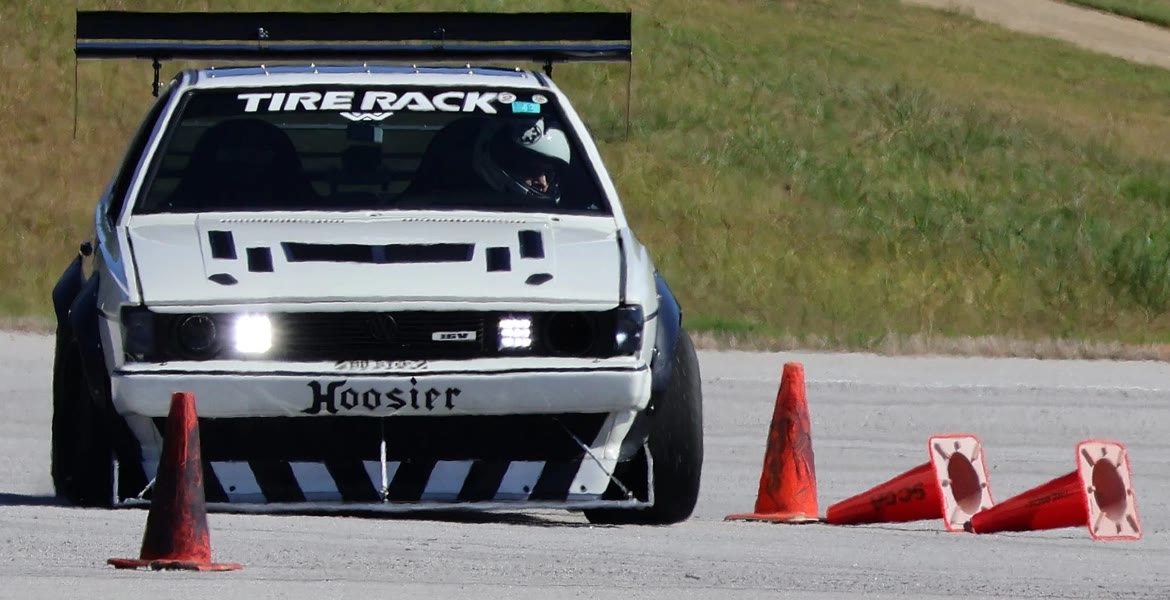
Never done this before
Your first
autocross
You need a car, a Saturday and nothing else. No license, no experience, no roll cage, no racing suit, nobody to vouch for you. Turn up in whatever you drove there in and we will walk you through the rest. This page is the whole thing, start to finish, so nothing on the day is a surprise.
Short answers first
01 — The worries"My car is not fast enough."
It does not need to be. You are timed against cars like yours, not against the fastest thing there. Slow cars are genuinely more fun to drive at the limit, and the best drivers here will tell you the same.
"I am not a good enough driver."
Nobody is on their first day. Every single person at that event was once exactly as lost as you will be on run one. It is the most forgiving place in motorsport to be bad at something.
"I do not know anyone."
Say so at registration and someone will take you under their wing. This is a volunteer club; being welcoming to newcomers is most of what keeps it alive.
"I will look stupid."
You will flatten some cones and go the wrong way at least once. So did everybody watching. The only thing people actually judge is whether you are safe and whether you did your work assignment.
"It will wreck my car."
Far less than a track day. Low speeds, runs under a minute, long cool-downs. You will use front tires and pads a bit faster than commuting does. That is the extent of it.
"I need to join something first."
No. Non-members run on a weekend membership included in the entry. Join properly later if you decide you like it.
Before the day
02 — PreparationRegister online
Entries open on MotorsportReg roughly a fortnight before each event. Pre-registering is cheaper than signing up at the gate and gets the paperwork done before you arrive. We normally have one event open at a time, so whatever is showing as open on the schedule is the one to enter.
Work out your class, or do not
Cars are grouped into classes so similar machinery competes together. You can look yours up with the SCCA classifier, but honestly, turn up and ask. Somebody at registration will sort it in about ninety seconds and they would rather do that than have you guess wrong.
Empty the car
Everything loose comes out and stays out: floor mats, the stuff in the door pockets, the phone charger, whatever is rolling around the boot. Anything left inside becomes a projectile, and tech will send you back to do it anyway.
Check the battery is properly tied down, look for fluid leaks, and make sure your wheel nuts are tight. That is the whole pre-event prep for a normal street car.
Sort your tires and fuel
Set your tires a few psi above your normal street pressure; the sidewalls take a beating in the slaloms. Bring a gauge so you can adjust between runs, because you will want to.
Arrive with at least half a tank. There is no fuel on site and you do not want to be hunting for a petrol station at lunchtime.
What to bring
03 — PackingTick these off as you pack. The list remembers itself on this device, so you can come back to it the night before.
Essential
You will want it
Only if you have one
No helmet? The club has loaners at no cost. You do not need to buy one to try this.
How the day goes
04 — The dayGates open
Roll in and find a spot in the paddock. Park somewhere with room to open the doors and unload. There is no advantage to being first through the gate, but arriving early means you get through everything below at a walk and with time to enjoy your coffee.
Registration and tech
Check in, sign the waiver, collect your numbers and confirm your class. Tell them it is your first event. That single sentence gets you a novice number, a mentor and a lot of patience.
Tech inspection is a quick look over the car: battery secure, nothing loose inside, no leaks, wheels tight, throttle returns, brakes work. A well-maintained street car does not meaningfully fail this.
Novice course walk
Ask for this by name. An experienced driver walks the course with the first-timers and explains what they are looking at: where the course is trying to trick you, which cone marks what, where to brake and where you can carry speed.
Then walk it again on your own, twice, slowly. Turn around at the end and look back the way you came. The course looks completely different from behind the wheel than it does on foot, and walking is the only cheap practice you get.
Drivers meeting
Everyone gathers. Safety briefing, run and work group assignments, anything specific to the course that day. Short, mandatory, and where you find out which group you are in.
Running starts
The field is split into three or four run groups. Across the day each group takes a turn at each job, so you will work a heat, sit one out and drive your own. The order depends on your group and it is posted before the drivers meeting.
Done, then cleanup
Autocross typically wraps around four o'clock. Everyone helps pick up cones and load the trailer; it takes twenty minutes with enough hands and it is not optional. Results go up, trophies are handed out at points events, and people stand around talking about the run they nearly had. Stay for that part, it is where you actually meet everyone.
Your actual runs
05 — DrivingYou get four runs on a normal day, and novices get five, because the first one is usually spent working out which way the course goes. Each run is roughly 45 to 65 seconds.
Take an instructor
Ask for one. They are volunteers, they ride along for free, and they will take more time off your day than any modification you could bolt to the car. They sit in the passenger seat and talk you through the course while you drive it.
There is no downside and no judgement in this. Experienced drivers take instructors too.
What the flags and lights mean
You will be waved off the start line when the course is clear. If something goes wrong ahead of you, a red flag means stop safely, straight away, and you will be given a rerun. Nothing about it is your fault and nothing about it counts against you.
Cones and what they cost
Knocking a cone over, or pushing it fully out of its painted box, is a two-second penalty. That is enormous on a fifty-second run, which is why people who look slow are often quick.
Missing a gate entirely is a DNF for that run: no time. It happens to everyone and it is not a big deal, it just means that run does not count.
Do not try to win run one
The universal advice from everyone here: drive your first run at about eight tenths and concentrate on going the right way. You cannot make up a lost course on lap time, and drivers who go flat out on run one usually spend runs two and three recovering their confidence.
Then build. The gap between your first run and your last is normally several seconds, and that improvement is the whole point.
Reading your results
06 — AfterwardsResults go up during and after the event, and live timing runs at ccrscca.prontolivetiming.com so you can watch your position from the paddock.
Three numbers matter:
- Your best run. Only your fastest counts, not an average. A disastrous run three costs you nothing.
- Your class position. How you did against cars like yours. This is the one that decides trophies and championship points.
- Your PAX or index time. Your raw time multiplied by a national handicap factor for your class, which lets you compare yourself with the whole field regardless of what anyone drove. It is how a well-driven Miata shows up alongside a Corvette.
Do not read too much into position one on day one. Read the gap between your own first and last runs instead. That number is the one that says whether you are learning, and it is usually a very encouraging number.
Everything else people ask
07 — FAQCan I really drive the car I came in?
Yes, and most people do. Street-legal and mechanically sound is the whole requirement. Front-wheel drive, all-wheel drive, automatic, manual, hybrid, EV, borrowed, leased: all of it has been autocrossed, much of it well.
Convertibles and tall vehicles have extra requirements around rollover protection. If you drive an SUV, a truck or anything with a high center of gravity, check with us before you enter rather than after.
Can I share a car with a friend?
Yes. It is called co-driving, it costs a second entry, and it is a very common way for two people to split a day. You run in different heats so you are never waiting on each other, and one of you can watch the other.
Can I bring my partner, kids or a dog?
Spectators are welcome and free. Everyone entering the property signs a waiver, including minors with a parent or guardian. Bring chairs; shade is not guaranteed at either venue.
Dogs are generally fine on a lead but check the specific venue's rules on the event listing before you commit to bringing one.
How long will I actually be there?
All day, and this is the thing that surprises people most. Gates at 7:00 AM, done around 4 PM, and you are expected to stay for cleanup. You are not there purely for your four runs; you are there to help run the event.
Plan the whole Saturday. Do not book anything for the evening on your first one.
What if it rains?
We usually run anyway. Wet autocross is slower, more sideways and a genuinely excellent way to learn car control at low risk, and plenty of people prefer it. Events are only called off for conditions that make the site unsafe, and you will hear about it through MotorsportReg and the club's social channels.
Do I need a special helmet?
Not to start. The club has loaner helmets at no cost, and plenty of people use them for a whole first season.
If you bring your own it needs a current Snell rating, which is listed in the Solo rulebook. Motorcycle helmets are not automatically acceptable; check the rating before you rely on it.
What does it cost?
One entry fee covers the day, and non-members pay a little more because it includes a weekend membership. Current pricing is on the event's registration page on MotorsportReg.
Pre-registering is cheaper than signing up on the day. We do not take cash: card or check only.
Where are the events?
zMAX Dragway in Concord, North Carolina and the Michelin Proving Grounds in Laurens, South Carolina. Each event's registration page has the exact address and gate details, and the full calendar is on the schedule.
I have more questions.
Ask them. Send us a message, or post in the club's Facebook group. Nobody minds a beginner question and everybody would rather answer it now than have you not turn up.
That is genuinely all of it.
Pick a date, enter, empty the car and turn up with a bottle of water. Tell us at registration that it is your first one and we will take it from there.