Discipline 02 · Appalachian Hillclimb Series
Hillclimb
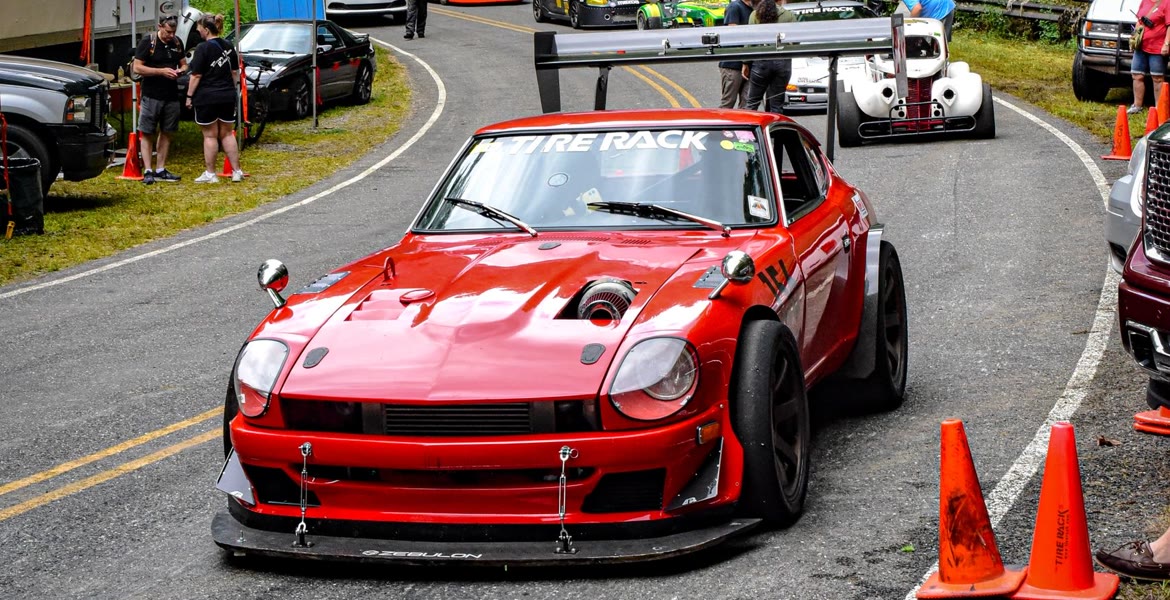
A public mountain road, closed for the weekend. You start at the bottom, alone, and drive it as fast as you dare. Blind crests, off-camber corners, trees and rock instead of runoff, and a clock that does not care how the view looks. Hillclimb is the oldest form of motorsport there is, and it is still the purest.
- Format
- One car, one roadTimed runs up a closed course. Nothing coming the other way, nothing beside you.
- 2026 season
- Five roundsClosed public roads across Kentucky, Tennessee, Virginia and North Carolina.
- Entry bar
- License requiredPlus full safety equipment and a car that passes a proper tech inspection.
- Run by
- Three regionsCCR runs the series jointly with the Blue Ridge and Eastern Tennessee regions.
What it actually is
01 — The basicsA section of mountain road is closed to the public for the weekend. Cars are released one at a time from a standing start at the bottom and timed to a finish line somewhere near the top. Between those two points there is no traffic, no oncoming cars, and no second chance to look at the corner you got wrong.
You get a handful of runs across the weekend. The road never changes, but the way you read it does, and the difference between your first run and your last is usually enormous.
How it differs from autocross
Autocross is a course invented that morning in a car park, and the consequence of a mistake is a flattened cone. Hillclimb is a real road with real edges. The speeds are much higher, the corners are blind, and the scenery is unforgiving in a way that a stadium lot simply is not.
That is why the entry bar is genuinely higher. This is not the discipline you start in. It is the one you graduate to once you have a season or two of seat time, a properly prepared car, and the judgement to know when you are out of talent.
The road is the whole thing
Learning a hillclimb course is a different skill to learning a cone course. You cannot see most of it from any one place, so drivers walk it, drive it slowly, take notes and video, and build a mental map of what happens over each crest before they commit to it at speed.
The people who win hillclimbs are rarely the ones with the most power. They are the ones who know precisely where the road goes.
It takes a village
A hillclimb only happens because a community lets us close their road, and because dozens of volunteers spend a weekend standing at corner stations with flags and radios. Marshalling is a genuinely good way to spend a hillclimb weekend if you are not ready to enter one, and it is the fastest route to understanding the course.
Getting in
02 — The route inDo a season of autocross first
It is not a formal requirement, but it is the honest answer. Autocross teaches car control at low consequence, and it is where you find out what your car does at the limit before the limit has trees behind it. Start here.
Come and marshal a round
Volunteer at a corner station for a weekend. You will watch a hundred cars take the same corner a hundred different ways, meet the people who run the series, and get a completely realistic picture of what you are signing up for. Nothing else comes close as preparation.
Sort the license and the gear
Work out which class you intend to run and what that class requires, then buy the safety equipment before you build the car. Ask the organizers directly rather than guessing; requirements change and the answer is specific to your class.
Prepare the car properly
Fresh fluids, good brakes, sound suspension and mounts, nothing loose, nothing leaking. Have someone experienced look over it before you tow it four hours to a mountain and find a problem in tech.
Enter, and take the first weekend slowly
Register on MotorsportReg, get there early, walk the road, ask questions of anyone standing near you, and treat your first competition run as a reconnaissance lap. The clock will still be there on Sunday.
2026 rounds
03 — CalendarResults & timing
04 — HillclimbThe Appalachian Hillclimb Series runs its own timing and keeps its own championship. It is a separate sanction from CCR autocross and road racing: different classes, different points, no crossover.
Straight answers
05 — FAQCan I run my street car?
In some classes, in some series, with the right safety equipment: sometimes yes. But hillclimb is not the place to find out casually. Check the current regulations for the class you want to run and speak to the organizers before you spend anything.
If the honest answer for your car and your experience is "not yet", autocross is the same club, the same people and the same weekend hobby, and it will take your daily driver tomorrow.
How fast does it actually get?
Considerably faster than autocross and, on the open sections, comparable to circuit racing. That, combined with the complete absence of runoff, is the whole reason for the license and equipment requirements.
Is it dangerous?
It carries more risk than autocross, and the sport is honest about that. The mitigation is layered: closed roads, one car at a time, flagged corner stations with radio communication, mandatory safety equipment, thorough tech inspection, and a culture that has no patience for people driving beyond themselves.
Drivers who treat the first runs as learning runs, and who stop when conditions change, have a good time and go home. That is the entire technique.
Where can I watch?
Spectating at a hillclimb is superb and usually free or close to it, but access is controlled for obvious reasons. Check the event listing for designated spectator areas and arrive before the road closes, because once it is closed you are staying where you are until a break in running.
When are the 2026 rounds?
Five rounds, listed in full above. Four have run; Shamrock Mountain on 25 to 27 September closes the season. Entry for every round is through MotorsportReg.
Start by watching one.
Come and marshal a corner, or just come and spectate. It costs you a weekend, teaches you more than any article can, and you will know by Sunday afternoon whether this is your sport.